Dependency resolution#
licenseal reports the whole dependency tree: what the manifests declare and everything those dependencies pull in. Resolution is lockfile-first:
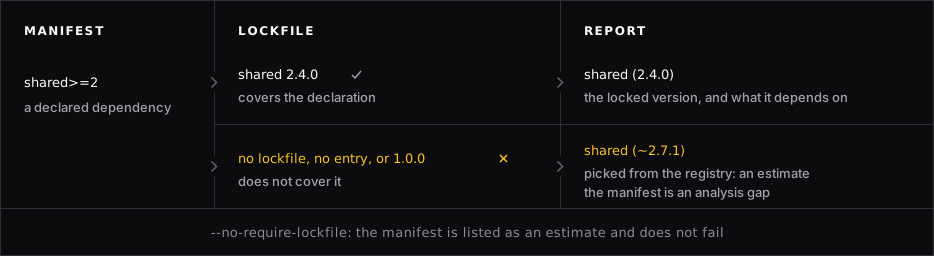
- If a lockfile is present (see Supported ecosystems), it is the source of truth.
- A lockfile covers a direct dependency only when it holds that package at a version the declaration admits:
shared>=2is covered by a locked2.4.0, not by a locked1.0.0. A locked version that cannot be compared with the declaration covers it too: a declaration with no constraint, a tag or a branch, and any range when the locked version is a prerelease. A declaration no lockfile covers is resolved through the registry (step 2). - A lockfile is read wherever it is found in the scanned tree.
- A lockfile covers a direct dependency only when it holds that package at a version the declaration admits:
- When no lockfile covers a dependency, licenseal falls back to a registry walk: each dependency's per-version metadata is fetched, breadth-first and in parallel (
--max-workers), down to--max-depth.- What the walk reports is an estimate: the versions are the ones the registries publish at scan time, not the ones the project installs. Every row it adds is marked as estimated (see Versions and estimates), and its manifest is a manifest without a lockfile.
--max-depth(default 50) bounds the registry walks of Python, npm, Rust, PHP, Ruby, and Hex. It does not bound a lockfile's graph, the deps.dev graph of a Maven or Gradle dependency, or the NuGet.nuspecwalk, which has its own limit of 32 levels. A walk that reaches the cap stops there; aWarning:says deeper dependencies may be missing, and it does not fail the check.
Direct dependencies only#
Transitive is the default. --no-transitive audits only the dependencies you declared directly: it takes no rows from a lockfile and reports no transitive.
Production or dev#
- A transitive is
prodwhen a production dependency pulls it in, otherwisedevwhen a dev dependency does, otherwise not reported. A scan without--devtherefore leaves out what only dev dependencies pull in. - A dependency declared as dev that a production dependency also pulls in is
prod, and--devadds rows without changing aprodrow todev. - When a lockfile holds none of the direct dependencies found in the manifests, all its packages are reported, as
produnless the lockfile format records its own dev/prod split.
Which declarations count as dev is listed on each ecosystem page. What a dev dependency does to a verdict is under How licenseal decides.