Security model#
licenseal is a license-assessment tool, not a security primitive. It reads manifests, calls public registries (read-only), and writes only the local outputs a user asks for (a report, a licenseal.review.toml scaffold, or the project-local Claude review skill): no code execution, no privileged operations.
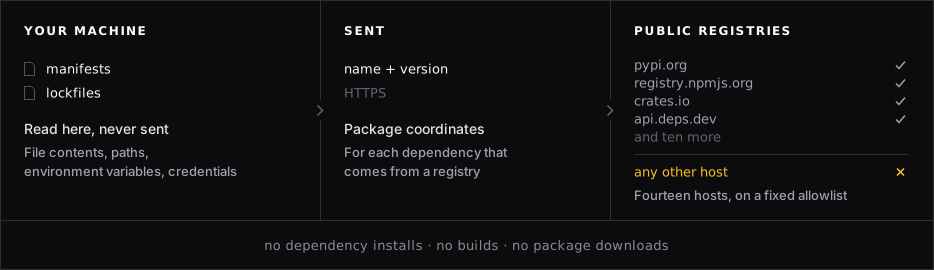
- What leaves the process: what a request carries, and when the name of a private package is sent to a public registry.
- Network egress: the fourteen hosts licenseal can contact, what each is asked, and how the allowlist is enforced.
- License sources: where each host's answer holds the license.
- What is scanned: which directories are read and which are skipped. The files read are listed for each ecosystem.
- Report output: how strings from registries and scanned files are escaped in a report.
- URL fields and trust: which URLs of a JSON report an agent can follow.
A package from a private registry is looked up by name on the public one. Read What leaves the process before you scan a project with internal packages.
Manifests and registries only#
licenseal's input is manifests and lockfiles on disk plus HTTPS reads from a fixed allowlist of public registries. It does not:
- download or inspect an artifact (
.jar,.whl,.tar.gz,.crate,.tgz, or any other built or source archive), even when the artifact holds a structured field that no registry exposes, such as theBundle-Licenseheader of a JAR'sMANIFEST.MF; - install or execute code of the scanned project (no
pip install,npm install,mvn,gradle,setup.py, or lifecycle scripts); - contact a registry that a scanned file declares, such as a POM's
<repositories>(see Network egress).
Four manifest constructs name other files to read. Each is followed only when its value is a relative path:
- An MSBuild
<Import Project="…">inDirectory.Build.props/.targets, and ago.workusedirectory, are followed through.., so the file read can be outside the scanned directory. - A
-r/--requirementline in a requirements file, and a setuptoolsfile:directive insetup.cfgorpyproject.toml, are followed only when they resolve to a file inside the scanned directory. A URL is never fetched, and-c/--constraintfiles are never read.
A rooted, drive-qualified, UNC, or device path is rejected by a lexical check before any filesystem call (on Windows, the first call on such a path can open a connection to a network share), and the manifest that contains it is reported as an analysis gap.
Files that decide a verdict#
licenseal.review.toml is a maintainer-approved override file. A malicious entry can mark a copyleft dependency as MIT and pass licenseal check in strict mode. Treat it as security-relevant:
- Require code review on every change to
licenseal.review.toml. - Give the reason for each entry in its
notefield. - Re-validate entries periodically when their resolved versions change upstream.
composer.lock decides a license directly too: the license field an entry embeds is used without a Packagist request, so an edited entry changes the verdict for that package. Review changes to composer.lock the same way.